

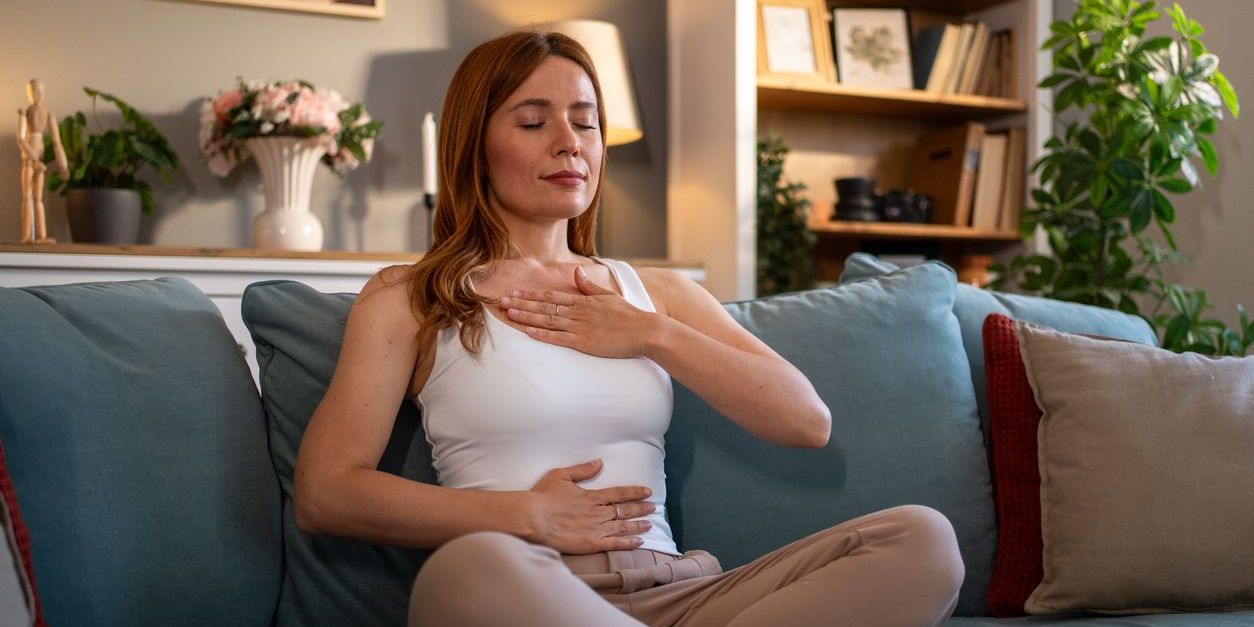
Summary: Breathing exercises reduce stress by influencing physiological systems and functions associated with the natural human stress response.
Key Points:
- Stress triggers a wide variety of responses in the human body, including changes in hormone activity, breathing rate, heart rate, and the activity of the sympathetic and parasympathetic nervous system.
- Some facets of the stress response are beneficial, but chronic stress can trigger dysfunctional physiological responses, with significant negative consequences for physical and mental health.
- Breathing exercises have a direct and measurable positive impact on both typical and dysfunctional physiological factors associated with the human stress response.
The Connection Between Breath and Stress
To understand the connection between breathing – what we may refer to in this article as the breath – and stress, it’s important to understand what happens in the human body when experience stress. On a basic level, we all know from experience what happens when we’re under stress. We may call it by different names, however, such as being nervous, being afraid, or being worried about things in our lives, both large and small.
When we’re nervous, afraid, or worried, we might experience:
- Chest tightening
- Heart racing
- Shortness of breath
- Sweaty palms
- Shaky hands/random trembles
- Nausea
- Other gastrointestinal issues
When things escalate, we may hyperventilate, have the same physical sensations, but more severe and extreme, and feel or enter what most of us would call a state of panic. People with anxiety – and mental health professionals – often call this a panic attack.
And what is a panic attack, exactly?
A panic attack is what happens when we enter our unconscious, automatic fight or flight response activates, resulting in physiological changes that lead to the sensations and feelings – a.k.a. symptoms – we list above.
When we enter fight or flight mode, we enter a physical state that’s been part of our evolutionary development for millions of years. Our body completely reorients its function, and prepares to face danger either by fighting or fleeing. There’s actually a third part of this automatic response, called freeze, but for the purposes of this article, we’ll refer to the stress response as fight or flight, rather than its full name, freeze, fight, or flight.
When our fight or flight response activates, our sympathetic nervous system sends signals to the brain to release neurotransmitters that stimulate our endocrine system, causing a cascade of stress hormones, including cortisol and adrenaline.
These hormones, in turn, cause the following physical reactions:
- Increased heart rate
- Diversion of blood from extremities to interna organs
- Increased breath rate/hyperventilation
- Increase in blood pressure
- Muscular tension
- Muscle tremors
- Excess sweating
- Dilated pupils
- Flushed face/pale skin, caused by diversion of blood away from extremities and skin surface to internal organs
In a typical fight or flight situation, the sympathetic nervous system causes the initial response. When the threat passes, the parasympathetic nervous system activates, effectively reversing the signals to fight or flee. The parasympathetic nervous system restores and resets our body back to its resting state. In the modern world, a near-miss while driving in traffic may trigger this entire series of events: the initial cascade of stress hormones, our automatic physical response, the course of action we choose, then a gradual restoration back to our typical state.
When Our Stress Response Goes Wrong
In some cases, our stress response malfunctions and remains active when there’s no real threat and no real need for the cascade of stress hormones in our bodies. This can happen to people:
- With anxiety disorders, including generalized anxiety disorder (GAD) and posttraumatic stress disorder (PTSD).
- Under chronic, persistent stress, which can include:
- Living in a war zone
- Experiencing physical, sexual, or emotional abuse
- Working in high stress occupations
- Who’ve had adverse childhood experiences
- With mental health disorders other than anxiety that share symptoms with anxiety disorders, such as:
When our stress response goes wrong, one thing that happens is that our parasympathetic nervous system, which is responsible for resetting our bodies, our entire nervous system, and our brains back to their typical, optimal functional state, fails to activate completely, and our bodies never truly reset. That leads to a host of problems. Chronic stress is associated with:
- Heart problems
- Hypertension/diabetes
- Impaired immune function
- Gastrointestinal issues
- Mental health problems, including anxiety, depression, and addiction
And that’s where the breath comes in. Breathing exercises reduce stress by activating the parasympathetic nervous system, which tells our body it’s now safe to calm down and relax because the threat has passed.
Direct, On-Demand Access to Your Stress Response
Breathing exercises reduce stress by giving you near-instant access to your parasympathetic nervous system, which attenuates the stress response. While the sympathetic nervous system – among other things – regulates the fight or flight response, the parasympathetic nervous system regulates our rest and digest response.
Rest and digest sound much less stressful than fight or flight, because it is. We can think of it as the opposite. Although that’s not technically accurate, opposite is a good way to think about it. Here’s how breathing exercises reduce stress through activation of the rest and digest response. Breathing exercise can:
- Reduce heart rate.
- Reduce breathing rate.
- Decrease blood pressure.
- Reduce levels of circulating stress hormones, including cortisol and adrenaline.
- Restore blood flow to all areas of the body.
- Reset digestive function.
- Release endorphins, which reduce physical pain.
- Decrease feelings of anxiety.
- Decrease feeling of depression.
- Improve cognitive function.
In the language of neurobiology and physiology, breathing exercises allow us to improve our vagal tone which improves our heart rate variability (HRV), which is how we measure the effective – or ineffective – function of our parasympathetic nervous system.
Now let’s take a look at which breathing exercises reduce stress by activating the parasympathetic nervous system and your rest and digest response.
Breathing Exercises to Reduce Stress
Evidence indicates the following breathing techniques activate the parasympathetic nervous system, improve vagal tone, and increase heart rate variability (HRV), all of which are associated with reduced stress, increased feelings of safety, and a return to a calm resting state.
When asked to take a deep breath, most people fill their chest first, with the upper torso and rib cage expanding. Diaphragm breathing, in contrast, involves training to breath from the bottom up. When inhaling, you lead with the diaphragm, expand the belly, then the lower ribs, then the chest. On the exhalation, you do the opposite. This technique activates the parasympathetic nervous system (PNS). Virtually all meditative breathing practices teach this type of breathing, which is often called belly breathing, or buddha breathing, after statues of the Happy Buddha, with a prominent belly.
Practicing diaphragm breathing at a rate of six (6) breaths per minute activates PNS and reduces stress.
To perform box breathing, you inhale for four (4) counts, i.e. seconds, hold the breath for four (4) counts, then exhale for four (4) counts, and repeat for several minutes. This activates the PNS and reduces stress.
To perform 4-7-8 breathing, you inhale for four (4) counts, i.e. seconds, hold the breath for seven (7) counts, then exhale for eight (8) counts, and repeat 4 times, twice a day. This activates the PNS and reduces stress. Evidence indicates a longer exhalation than inhalation leads to fast and efficient activation of the PNS, compared to other breathing techniques.
To perform alternate nostril breathing, you place your hand in front of your face so that your thumb can rest on one nostril, and one of your fingers – whichever lands there naturally – on the other nostril. First, use your thumb to close that nostril as you inhale through the other. Next, release your thumb, close the other nostril with a finger, and exhale through the nostril your thumb was on. Next, inhale through that same nostril, release your finger from the closed nostril, and exhale through that nostril as you replace your thumb on its nostril. That’s one cycle. Repeat for around three to five minutes at least twice a day.
You can practice any of those breathing exercises to reduce stress. They’re easy to learn, work immediately for most people, and you can practice them nearly anywhere, at any time. However, we caution against doing any real deep breathing work/breath work while driving a car. Otherwise, you can try any or all of these breathing exercises to reduce stress, starting right now.


