

Summary: Mindfulness techniques that help mental health treatment include, but are not limited to mindful meditation, yoga, and tai chi.
Key Points:
- Research shows significant benefits for the use of mindfulness in mental health treatment.
- Mindfulness techniques that help mental health treatment typically involve increased awareness, physical relaxation, and a focus on breathing.
- Relaxation and awareness associated with mindfulness can reduce stress and improve emotional regulation, which can improve mental health outcomes.
What Exactly is Mindfulness in Mental Health Treatment?
When we talk about mindfulness in the context of mental health treatment, what we mean is the type of mindfulness most often associated with the Buddhist monk Thich Nhat Hanh, who defines mindfulness as follows:
“Mindfulness is our ability to be aware of what is going on both inside us and around us. It is the continuous awareness of our bodies, emotions, and thoughts.”
That’s the core of mindfulness, but that’s not everything. It’s only the first step. The second step of mindfulness – which comes after awareness – is acceptance. Once we recognize what’s going on in our bodies, emotions, and thoughts, we accept what we become aware of, one hundred percent, and recognize it as the reality of what’s really going on inside us. But that’s still not everything. There’s a third step. Once we become aware of what’s going on, accept that what’s going on is our current reality, the final step is to refrain from judging what’s going on inside ourselves as good, bad, or anywhere in between. In the third step in basic mindfulness techniques, we practice nonjudgment.
Therefore, in the context of mental health and mental health treatment, mindfulness means the following three things:
- Awareness of what’s going on with us – mind, body, and emotion.
- Acceptance of what’s going on with us – mind, body, and emotion.
- Nonjudgment of what’s going on with us – mind, body, and emotion.
Once we can see our current mental, physical, and emotional state and/or circumstances clearly, without our habitual, learned mental commentary or reactive emotional input, we can make better decisions, regulate emotions more effectively, and manage our behavior in ways that we choose, rather than engaging in default and potentially maladaptive behaviors guided by unconscious, conditioned responses developed over years, in response to various events – positive and negative – in our lives.
Mindfulness and Mental Health Treatment: What Works the Best?
Evidence for mindfulness in mental health treatment published by the National Center for Complementary and Integrative Health identifies at least three effective approaches:
- Mindful meditation: Meditation and Mindfulness: What You Need to Know
- Yoga: Yoga: What You Need to Know
- Tai chi: Tai Chi: What You Need To Know
Those articles can give you a good preliminary summary of the information we share below, with links for further reading on each topic, from infographic explainers to in-depth peer-reviewed research. We’ll start our discussion with the first item on the list of mindfulness techniques that help mental health treatment.
Meditation: The Mindful Approach
Peer-reviewed research and articles written for general audiences report that mindfulness techniques during mental health treatment can improve outcomes for the following mental health disorders and/or challenges:
- Major depressive disorder (MDD)
- Generalized anxiety disorder (GAD)
- Post-traumatic stress disorder (PTSD)
- Other stress-related problems
- Sleep problems/insomnia
Mindfulness can also help people manage both the emotional and physical consequences of physical issues including, but not limited to:
- Chronic disease/illness, i.e. hypertension
- Chronic pain
- Major disease/injury
In addition, mindfulness can help people during addiction treatment. To learn more, read this article on our blog:
Can Mindfulness Help Addiction Recovery?
Spoiler alert: yes, mindfulness can help addiction recovery.
Now let’s take a closer look at the types of mindful meditation that help mental health treatment:
Progressive muscular relaxation (PMR):
This mindfulness practice can be performed in a variety of ways. Laying comfortably on a yoga mat, exercise mat, or at home in bed are most common, but it’s possible to do PMR while standing or sitting. To perform PMR, patients focus their attention – their mindful attention – on each major muscle group, one after the other. Patients start macro and gradually shift to micro, meaning first they relax the legs, the arms, and the torso. Next, they get specific, and relax the muscles of the head, face, and neck, working from the head to the toes. PMR can be relatively quick – five minutes or less – or relatively long, depending on how specific and detailed the patient wants to get, and how much time they have for the session.
The purpose of PMR is to promote relaxation by recognizing and identifying how each part of the body feels in the here and now – nonjudgmentally – and working with the breath to let go of any unwanted muscular tension.
Seated meditation.
In most cases, a seated meditation session focuses closely on the breath and breathing. Patients start by finding a comfortable seated position, relaxing the body, and using the breath to focus the mind. Note: patients can practice seated meditation in whatever seated position is comfortable for them. A chair works just as well as sitting cross-legged on the floor in a classic meditation posture. Again, the focus is typically on breathing and breathing only. The specific seated position is only important in that it promotes a relaxed body and mind: nothing else matters. When random thoughts, distressing thoughts, or thoughts about anything but breathing appear, the patient simply calls their attention back to the natural rhythm of their breathing and continues meditating.
That’s the foundation of the practice: learning to sit, breath, and allow thoughts and emotions to come and go without judging them, reacting to them, or giving them additional energy of any kind.
Moving mindfulness meditation.
When experienced mindfulness practitioners think about moving meditation, the first thing that comes to mind is mindful walking, mostly because it’s a technique popularized by Thich Nhat Hahn. Mindful walking is easy to learn, easy to do, and easy to work into a busy daily schedule. However, there are several different activities that readily qualify as moving meditation. We discuss yoga and tai chi below, but it’s possible to transform almost any activity involving movement into moving meditation: dance, martial arts, cycling, and working in the garden are all good candidates for moving mindful meditation.
Yoga as Mindfulness to Help Mental Health Treatment
Yoga may be the most complete and integrated mindfulness system among all approaches to mindfulness. A yoga practice involves conscious integration of body, breath, and mind. Patients who take yoga classes as part of mental health treatment will practice the following:
- Mindful breathing. Every yoga session begins and ends with a focus on breathing. Imagine a yoga teacher in any context, and the first thing you might hear them say is “Take a breath in, lengthen your spine, then exhale and relax.” It doesn’t matter what you just did or are about to do: they always bring it back to breathing. Note: if they don’t, consider finding a different teacher.
- Postures and series of postures. A typical yoga class involves a series of movements that take you to static positions – called poses or asanas – that you hold for a period of time, typically measured by a specific number of breaths. These asanas not only improve physical health, but also improve attention, awareness, and concentration, all of which help improve outcomes for people in mental health treatment.
- Guided relaxation. The PMR technique we describe above is lifted straight from a yoga pose where practitioners lie on the floor and relax their bodies from head to toe, then spend 10-15 minutes – in a traditional class format – simply following their breathing in and out, identifying physical sensations and thoughts without judgment. If that sounds exactly like a combination of mindful meditation and PMR, that’s because that’s exactly what it is. Mindful meditation and PMR are both derived from this ancient yoga practice, which predates Buddhist meditation.
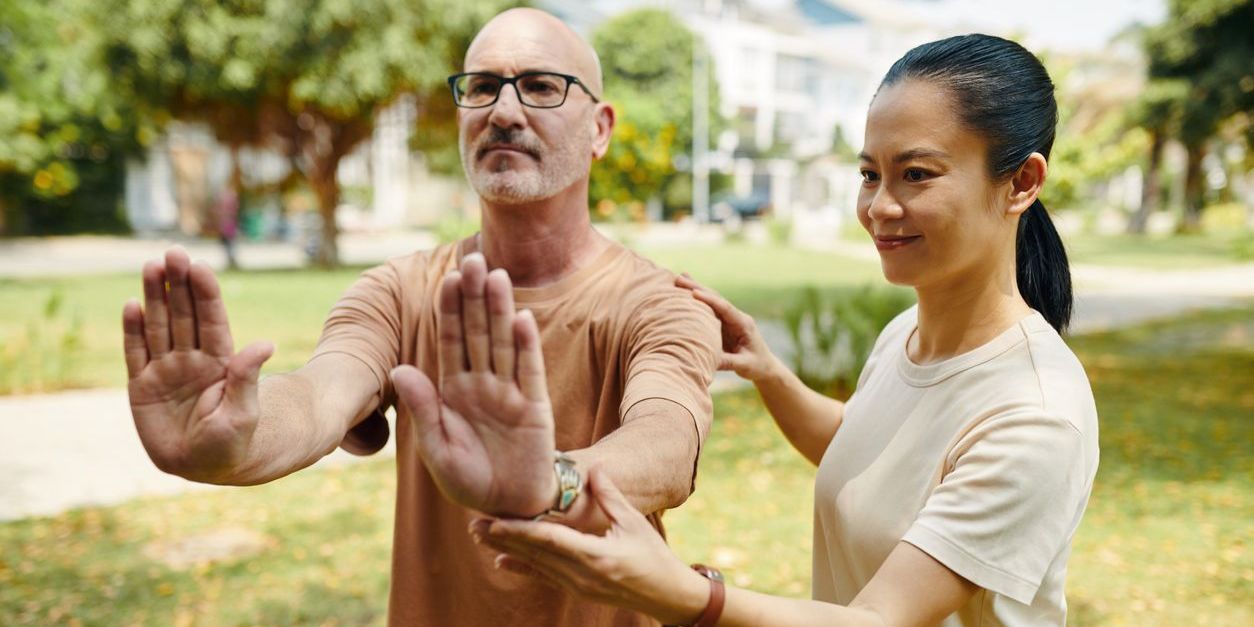
Tai Chi: A Mindful Approach to Movement
When people hear the phrase moving meditation, most think tai chi. They’re not wrong. Like yoga, tai chi relies on the conscious integration of mind, body, and movement. Tai chi, as we know it here in the U.S., is a combination of traditional Chinese kung fu and traditional Chinese chi kung. In the 17th century, martial artists incorporated the healing philosophy of chi kung, which translates as energy work, with soft, circular movements derived from kung fu styles based on animal movements – specifically snake and crane – to create tai chi chuan. Over time, tai chi has largely lost its martial component – though some people still know and practice martial tai chi – in favor of its healing, restorative, and meditative components.
Therefore, when you see films of older Chinese people doing slow, circular, relaxed movements for health and longevity, what you’re watching is people using their mind, in coordination with their breath, to move their chi, i.e. their energy, throughout their bodies.
Evidence shows practicing tai chi can improve the following aspects of mental health:
- Consistent tai chi sessions can result in increases in positive mood.
- Consistent tai chi sessions can reduce cortisol, thereby decreasing stress.
- Consistent tai chi sessions can decrease depressive symptoms.
- Consistent tai chi sessions can decrease symptoms of anxiety.
- Overall wellbeing. Consistent tai chi sessions can improve an overall sense of wellbeing.
To be clear, when we talk about all of these mindfulness techniques that help mental health treatment, we understand them as complementary supports for first line treatments. That means the mindfulness techniques we describe above – mindful meditation, yoga, and tai chi – all help mental health in addition to gold standard treatment approaches like psychotherapy, medication, peer support, and lifestyle changes.
Mindfulness is Portable and Never Expires
When you learn mindfulness, and it works for you, it sticks.
Why?
Because in most cases, the people for whom mindfulness works feel like it makes perfect sense, is relatively easy to learn, and works almost right away. In other words, they tend to feel like it’s something they’ve always known about but just needed a reminder.
If mindfulness works for you, then the whole approach is yours, forever. It’s very difficult to forget or unlearn a mindfulness technique once you know it. The same is true for yoga, and to a slightly lesser extent, for tai chi. Once you learn the basics of yoga, you can practice on your own, wherever you are, whenever you want: all you need is a little time and space. Tai chi movements are more complicated, which makes them easier to forget, but once you learn tai chi, you can practice it wherever and whenever you want, for the rest of your life.
Mindful meditation and mindful breathing have them both beat, though, for longevity and portability. You can practice mindful breathing in literally any situation. Once you learn it, you can practice it standing in line at the grocery store, sitting at a conference table in a work meeting, or in your garden on a Sunday morning – and it works perfectly. With mindfulness, what matters is you. If you put the time and effort in on the front end, there is no expiration date on that knowledge: it’s yours to keep and use for as long as you choose.


