

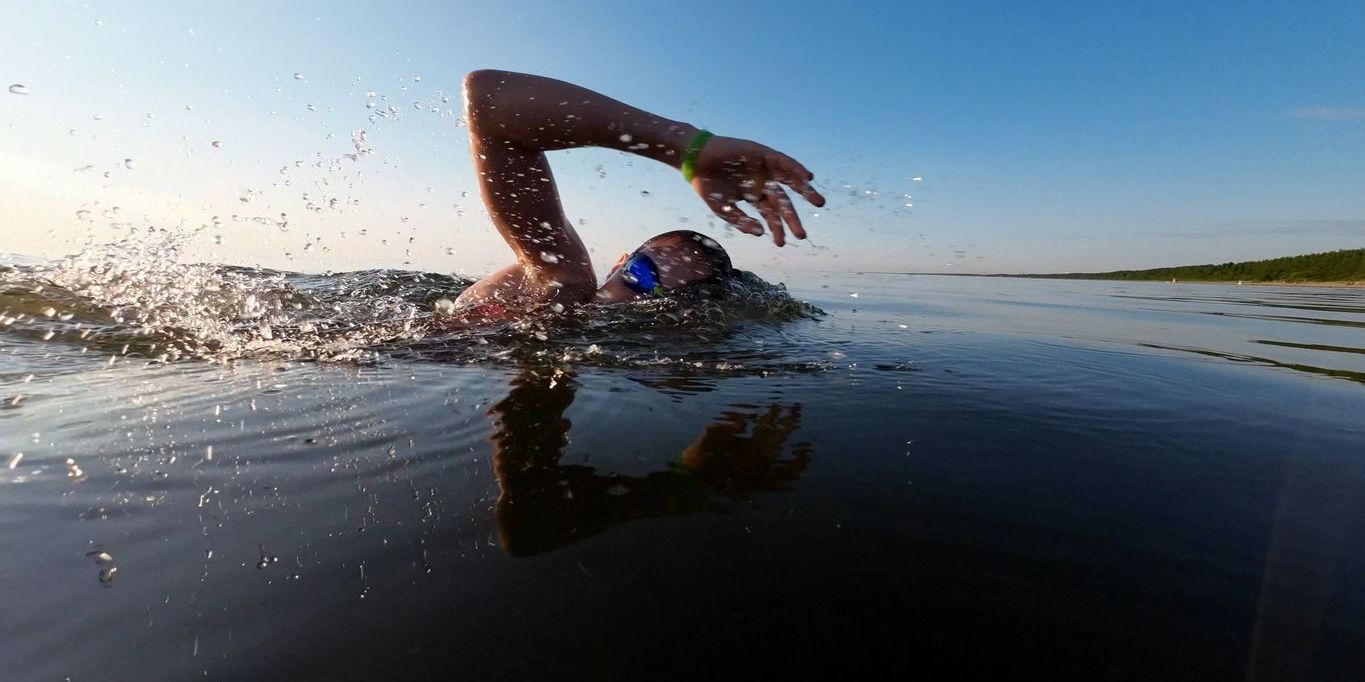
Summary: Yes, open water swimming can benefit mental health. Open water swimming (OWS) means swimming in any natural body of water, including the ocean, rivers, lakes, and streams, as opposed to swimming in a human-made swimming pool.
Key Points:
- Decades of research document the positive impact of nature – most often referred to as greenspace – on mental health.
- Recent research documents the positive impact of blue space – often called blue zones, defied as living within a mile of the ocean – on mental health.
- New research explores the effect of swimming in nature, a.k.a. open water swimming, on mental health and wellbeing.
Greenspace, Blue Space, and Swimming in Open Water
In recent years, an expanded understanding of mental health disorders and treatment for mental health disorders has led to the inclusion of nature and nature-based activities in mental health treatment. Depending on the provider and/or the treatment center offering this type of support, the integration of greenspace into mental health treatment may be called:
- Adventure therapy
- Nature therapy
- Experiential therapy
These names all refer to the same basic concept: spending time in nature improves overall wellbeing, and has a positive effect on people with mental health disorders such as depression, anxiety, and substance use disorder, or addiction. In this article, we’ll focus on the impact of spending time in nature on mental health, and discuss the impact of spending time in nature on addiction in a forthcoming article.
The research we mention above establishes the benefits of greenspace for mental health, which include:
- Reduced stress
- Decreased diagnosis of clinical mental health disorders, including:
- Generalized anxiety disorder (GAD)
- Major depressive disorder (MDD)
- Mood disorders, such as bipolar disorder
- Reduced psychological distress
- Decreased depressive symptoms
- Reduce symptoms of anxiety
Research on blue spaces shows similar benefits for mental health: reduced stress, depression, anxiety, and improved overall wellbeing. Additional research identifies the benefits of exercise for mental health, with well-documented positive effects on mood, wellbeing, self-esteem, and symptoms of depression.
A new meta-analysis/review paper – Swimming in Nature: A Scoping Review of the Mental Health and Wellbeing Benefits of Open Water Swimming – examines the available evidence on what happens when we combine direct contact with nature, in the form of open water, with exercise, in the form of open water swimming (OWS).
Let’s take a look at that study, and learn what they found.
Open Water Swimming and Mental Health
To clarify, open water swimming means swimming in a blue space, and may be called wild swimming, cold water swimming, or simply outdoor swimming. Previous research identifies the following benefits of OWS:
- Improved mood
- Increased energy
- Increased libido
- Reduced stress
- Reduced tension
- Improved memory
In addition, studies show that OWS can improve social connections, give practitioners a sense of achievement, and provide a healthy, stabilizing routine.
The current study reviewed the available scholarship on OWS by examining the results of 14 peer-reviewed studies on the topic. Researchers examined quantitative, qualitative, and mixed-design studies, and identified nine distinct components of OWS that contribute to positive mental health, which all support the idea that open water swimming can benefit mental health.
Nine Ways Open Water Swimming Can Benefit Mental Heath
1. Immersion.
People who OWS report that the full-body, full-sensory experience of immersing themselves in water makes them feel connected to the natural world and “at one with the water.”
2. Relationship with wild water.
An awareness of the risks of OWS led to a more intimate knowledge of themselves, and increased levels of humility and respect for themselves and others. In addition, people who OWS say the feeling of weightlessness and buoyancy experienced in saltwater was liberating, and allowed them to “literally let the body go.”
3. Therapeutic nature of blue space.
People who OWS report that for them, blue spaces became a place to heal and grow, calling blue spaces “a refuge from mental health problems.”
4. Embodiment.
This concept involves the power of OWS to move a person from preoccupation with the thoughts in their mind to an experience of feeling in the body. Union with the water brought relief, with one participant noting “…the body finds a rhythm; stroke, stroke, breathe. Everything is contained and produced in that repeated motion.” This vacation from thought and direct experience of the body relieved stress, and led to the experience of a cleansing ritual.
5. Mindfulness.
Many people who OWS reported that “…time in the water impacted how they manage their daily lives by disrupting habits and offering a new perspective on the world,” indicating that OWS was similar to a “reset button” that enhanced and promoted awareness and mindfulness.
6. Stronger mind and body.
People who OWS get a stronger body through the exercise/activity of swimming, and a stronger mind by facing and overcoming their fears of swimming in an uncontrolled, unregulated, unpredictable body of water. One researcher noted “Over the course they reported increased confidence…and being more able to manage unexpected challenges as a result of new coping strategies and a greater self-confidence.”
7. Connection with others.
When people share a difficult experience, it bonds them. People who OWS report establishing deep and meaningful connections, whether overt or implied. Some enjoyed the banter associated with the major and minor details of OWS, while others enjoyed participating in an activity with others but without the need to talk.
8. Improved sense of purpose.
When OWS becomes a regular daily or weekly routine, some people who participate in OWS report that their scheduled swims “provided a backbone” to their day, gave them something to look forward to, and improved their overall subjective sense of community.
9. Enhanced concept of self, more clearly defined identity.
Multiple experiences with OWS helped people recognize and value the lessons of the activity, such as independence, learning, and growth. Many reported that being in the sea “…they felt the same sense of enjoyment they had as a child,” which helped them restore and rebuild a positive and powerful sense of self.
We’ll discuss these outcomes below.
The Benefits of Open Water Swimming for Mental Health
The study authors describe the positive results of swimming in nature and spending time in blue space as both qualitative and quantitative.
Quantitative outcomes included:
- Improved mood
- Reduced mental health symptoms
- Improved wellbeing
Qualitative outcomes included things like more connection with others, improved mindfulness, and an enhanced sense of purpose in life. All of these outcomes can improve mental health. They also offer clear and compelling reasons to include activities like OWS in mental health treatment.
We’ll give the study authors the last word on this topic:
“Overall, there was a clear finding that OWS allows connection with oneself, the water and others, and this was experienced as offering many benefits to MH [mental health] and wellbeing, directly, indirectly, and reciprocally.”
We encourage anyone who needs mental health support to consider how open water swimming can benefit mental health, and find a way to incorporate OWS into their approach to mental health treatment and recovery.


